



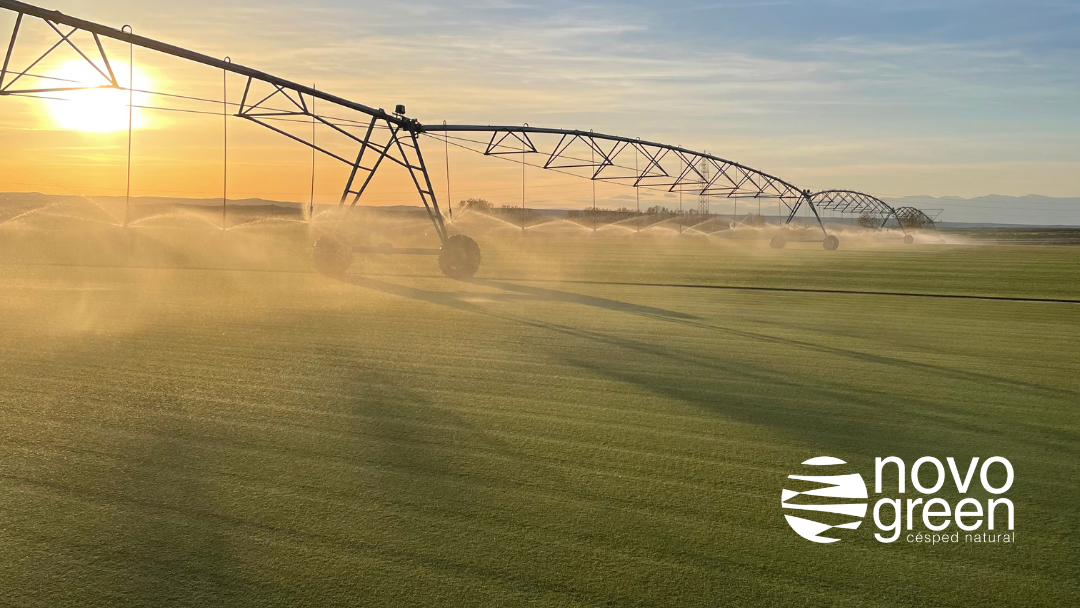
Water conservation has become a key consideration when designing and maintaining gardens, green spaces, sports facilities, and golf courses. However, when it comes to natural grass, reducing water consumption isn't simply about watering less.
Two seemingly similar surfaces can have very different water needs. Final consumption is not determined by a single factor, but by the relationship between... the plant material, the environmental conditions, and the surface management.
Therefore, the question “Which grass uses less water?” It has an incomplete answer if we don't know the project beforehand.
The really useful question is something else:
Which species and variety can offer the level of quality we need while using resources as efficiently as possible?
Answering that question correctly allows you to reduce water consumption without unnecessarily compromising the quality, functionality, or durability of the lawn.
Table of Contents
Water consumption does not depend solely on the species
There is no universal figure of liters per square meter that can be applied to any lawn.
Water needs depend on the evapotranspiration, which in turn is conditioned by factors such as temperature, solar radiation, wind and ambient humidity. But many other variables are also involved:
- species and variety
- soil type and depth
- root system development
- sun and shade exposure
- water quality and salinity
- traffic level
- height and frequency of mowing
- nutrition
- time of year
- required level of visual or functional quality
A sports field subjected to intensive use does not have the same requirements as a residential garden. Nor can a golf green be managed with the same criteria as an extensive green area or a hotel garden.
Therefore, Water efficiency must be analyzed within the overall project, and not as an isolated feature.
Choosing a species adapted to the climate is the first step
One of the decisions with the greatest long-term impact is the choice between cold climate species or C3 and warm-climate species or C4.
C3 species, which include Festuca arundinacea, Lolium perenne, Poa pratensis or Agrostis, They generally perform best at moderate temperatures. They are essential in many areas and applications and can maintain good activity during the cooler periods of the year.
However, when temperatures rise considerably, certain C3 plants may suffer greater heat stress and require more resources to maintain a high level of quality.
C4 species, such as Bermuda, Zoysia or Paspalum, They utilize a different photosynthetic pathway and are specially adapted to high temperature and high radiation conditions. Under suitable conditions, they can exhibit high water use efficiency and excellent heat tolerance.
This difference is especially relevant in Mediterranean climates and in areas with long, hot summers.
But that doesn't mean a C4 is automatically the right solution for every project.
C3 or C4: behavior must be assessed throughout the year
The choice should be made by analyzing the expected behavior during the twelve months and, especially, during the periods of greatest use of the surface.
C4 species reduce their vegetative activity as temperatures drop and may enter winter dormancy, temporarily losing their green color. The intensity and duration of this process depend on the species, variety, and climatic conditions.
This temporary loss of color is primarily an aesthetic change and does not mean the grass is dead. The surface can continue to be used, although its ability to recover from wear and tear is reduced during dormancy.
This should be taken into account when maintaining color during the winter is a priority requirement., But the choice must also consider the behavior of the surface during the summer season.
A C3 species can retain activity and color during the cold months and yet require greater water inputs or more intensive management to maintain quality when faced with high temperatures.
In gardens, hotels, resorts, pool areas, tourist areas, sports facilities and numerous green spaces, The period of peak usage coincides precisely with the warmest months., when C4 species are in full active growth.
Therefore, the sustainability of a surface should not be assessed solely based on its appearance at a particular time of year. Other factors must be considered. the resources needed to maintain the required level of quality throughout its annual cycle.
Variety can be as important as species
Talking about Bermuda, Zoysia or Festuca is still insufficient when you want to make a technical selection.
Within the same species, there are significant varietal differences in aspects such as:
- drought tolerance
- water needs
- heat resistance
- behavior in the face of cold
- latency duration
- traffic tolerance
- recovery capacity
- resistance or tolerance to certain health problems
- shade tolerance
- salinity
- growth rate
- mowing and fertilization needs
This genetic evolution is one of the most relevant changes that have occurred in the natural grass sector.
New varieties are not selected solely for their color or texture. Genetic improvement programs also work on characteristics related to drought, temperature, traffic, recovery and reduction of inputs.
Therefore, two varieties belonging to the same species can behave significantly differently under the same conditions.
TifTuf: an example of why varietal selection matters
A good example is Bermuda TifTuf, a C4 variety developed by the University of Georgia after years of selection for its performance in the face of drought.
Trials conducted by the university itself have shown water consumption approximately one-third lower than that of the reference Bermuda area under certain conditions, while maintaining quality and recovery characteristics. The University of Georgia currently notes reductions of up to 38 % compared to varieties previous in their research work
The most recent trials continue to show advantages of TifTuf over Tifway in indicators related to drought performance and maintenance of green cover. (Source) CAES Field Report)
This does not mean that a specific percentage of savings can be automatically extrapolated to any project. Final consumption will still depend on the climate, soil, irrigation system, maintenance, and required quality.
What's important is what it demonstrates from an agronomic point of view: Selecting a genetic variety specifically adapted to water stress can significantly alter the needs of a lawn area..
And this same criterion should be applied when comparing other Bermuda, Zoysia, Paspalum or C3 varieties.
Water efficiency and drought tolerance do not mean exactly the same thing.
Although they are often used together, it is important to differentiate between the two concepts.
The water use efficiency It refers to the plant's ability to utilize available water and maintain its activity by using resources efficiently.
The drought tolerance It describes its ability to withstand periods of limited water availability without suffering excessive deterioration or permanent damage.
In addition, different varieties may use different mechanisms to respond to water stress: root systems capable of exploring a larger volume of soil, regulation of water loss through the leaves, physiological responses to stress, or the ability to recover when water becomes available again.
Therefore, simply saying that a lawn is "drought resistant" provides little information if we don't know what level of quality can it maintain, for how long, and under what conditions.
How much water can actually be saved?
It is one of the most common questions and also one that requires the most caution.
There is no single savings percentage that applies to any installation.
As we have seen, there are specific varieties with trials that demonstrate significant reductions compared to reference materials. But automatically applying those results to any garden, football field, resort, or golf course would be incorrect.
The actual savings will depend, among other factors, on:
Variety of starting points. Replacing a variety with high water requirements offers a different margin for improvement than starting with an already efficient lawn.
Climate. Temperature, radiation, wind, humidity and precipitation directly influence water demand.
Floor. Its ability to infiltrate, store and make water available to the roots is crucial.
Irrigation system. Poor uniformity can simultaneously create areas with water deficits and areas with excess water.
Maintenance. Mowing, nutrition, aeration, and compaction affect root development and the response to stress.
Required quality. Maintaining a surface at a maximum aesthetic or sporting level permanently may require a different strategy than allowing moderate and recoverable stress.
That's why it's more accurate to talk about potential for reducing water consumption than promising a universal savings percentage.
Soil is a fundamental part of water efficiency
We can choose a variety with excellent drought performance and lose much of that advantage if the soil does not allow for proper water use.
Very sandy soil may have limited water retention capacity. Excessively compact soil can hinder infiltration, promote runoff, and limit root development. Soil with drainage problems may remain saturated in certain areas while other parts of the surface are deficient.
Before laying a lawn, it is advisable to consider aspects such as:
- texture and structure
- infiltration and drainage
- effective depth
- compaction
- organic matter content
- salinity, when relevant
The goal is to promote a healthy and sufficiently developed root system.
The greater the volume of soil that the roots can explore, the greater the plant's ability to use stored water and cope with periods between irrigations.
That's why, when we talk about saving water, a significant part of the work happens below the surface.
Water quality can also change the decision
Not all projects have water with the same characteristics.
In coastal areas, golf courses, resorts and large landscape developments it may be necessary to use reclaimed water, water of poorer quality or resources with higher than usual salt concentrations.
In these situations, reducing consumption is not the only goal.
We must also ask ourselves:
What quality of water does the grass we have chosen need?
Here, species such as Paspalum vaginatum, characterized by a high tolerance to salinity.
Within our range we work with varieties such as SeaIsle 2000 and Platinum TE, especially interesting when water quality or soil salinity is a relevant factor.
This introduces another dimension to sustainability: It's not just about how much water we use, but also what kind of water resource we can use in an agronomically viable way..
A variety capable of developing properly with higher salinity waters can reduce the need to resort to higher quality resources, provided that the soil design, drainage and salt management are adequate.
Saving water is not about superficial irrigation.
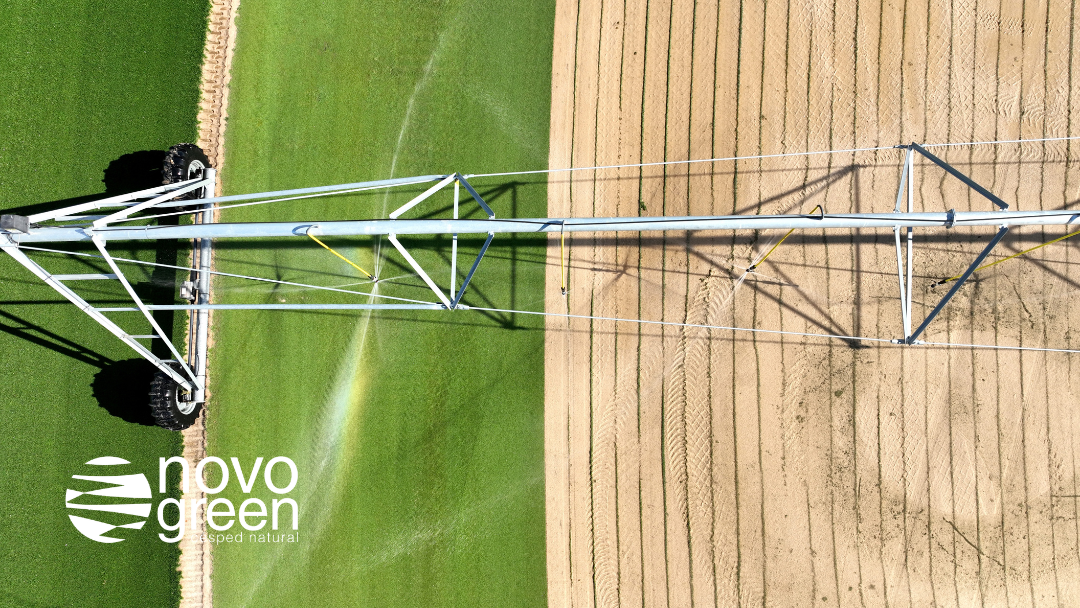
Once the surface area is established, irrigation management can enhance or negate many of the advantages obtained through varietal selection.
In an established lawn, applying small amounts of water too frequently keeps mainly the surface area of the soil moist and can encourage a shallower root system.
As a general rule, it is important to carry out Watering should be deep enough and the frequency adjusted to the actual needs of the plant and the capacity of the soil., instead of maintaining a fixed schedule regardless of the conditions.
This should not be confused with management during implantation.
A newly installed sod needs to maintain adequate moisture while it develops new roots and integrates with the receiving soil. Similarly, a newly seeded area initially requires more frequent watering to ensure germination and establishment.
Once the grass has settled, the strategy changes.
The goal becomes to promote a root system capable of exploring a larger volume of soil and avoiding both excessive stress and unnecessary inputs.
The timing of watering also matters
As a general rule, The early morning hours are the most suitable time for watering..
Temperatures are usually lower than during the middle of the day, and evaporation losses are reduced. At the same time, it avoids keeping the surface unnecessarily damp throughout the night.
This does not mean that irrigation may never be necessary at other times in specific stress situations, but rather that the usual schedule should aim for maximum water use and suitable agronomic conditions.
In large areas, hydraulic limitations and the time required to complete irrigation cycles necessitate the design of specific strategies.
Before increasing irrigation, its uniformity must be checked.
When a dry area appears, the first reaction is usually to increase the watering time.
It's not always the right decision.
The problem may lie in:
- a partially clogged nozzle
- a misdirected sprinkler
- a pressure difference
- insufficient overlap
- wind during irrigation
- significant differences in the soil
- localized compaction
If we increase the operating time of the entire sector to correct a single deficient area, we may end up applying an excess of water to the rest of the surface.
A simple test using collection containers distributed at different points It allows you to know how much water is actually reaching each area and to detect uniformity problems.
In more complex installations, this information can be supplemented with humidity sensors, weather stations, and intelligent control systems.
Technology allows for much finer management, but it must be used on a hydraulically correct installation and accompanied by agronomic criteria.

Shade also modifies water needs
Shaded areas are another example of why an entire surface should not be managed with a single recipe.
An area with lower solar radiation may have lower evapotranspiration and therefore require less water. However, if the shade comes from trees, there may also be root competition for water and nutrients.
Furthermore, excessively persistent humidity can contribute to certain health problems.
Therefore, the answer is not to automatically water more or less, but to divide into sectors and observe the actual behavior of the surface.
We must also consider variety.
There are significant differences in shade tolerance between species and cultivars. Some Zoysias may exhibit good relative tolerance to lower radiation conditions, while Bermuda grasses, as a group, perform best in high sun exposure, although varietal differences also exist.
Once again, selecting solely by species may not be enough.
Mowing, nutrition, and traffic also influence water consumption
Water management cannot be separated from general maintenance.
An inappropriate mowing height can put unnecessary stress on the lawn. As a general rule, the recommended height for each species and variety should be respected, and no more than approximately one-third of the blade should be removed in a single mowing.
Nutrition must also be adjusted to the plant's actual needs. An excess of nitrogen can lead to unnecessary vegetative growth, increase mowing requirements, and alter the plant's response to certain types of stress.
A frequently used surface can suffer compaction, This reduces infiltration and limits root development. In these cases, practices such as aeration can be part of a water management strategy even if they are not seemingly related to irrigation.
Therefore, reducing water consumption requires considering together genetics, soil, irrigation and maintenance.
Which lawn should you choose when saving water is a priority?
There is no single answer, but there is a correct way to approach the decision.
Before select a species or variety We should know at least:
- Climate.
Maximum and minimum temperatures, duration of summer, risk of frost, precipitation and radiation. - Use.
Gardening, landscaping, golf, football, other sports facilities, hotels, resorts or public green areas have different requirements. - Traffic.
We must not only assess how much wear the surface will withstand, but also what recovery capacity we will need. - Floor.
Texture, drainage, compaction, and depth directly influence water availability. - Quantity and quality of water.
In addition to knowing how much of the resource exists, it is important to know its characteristics and possible salinity problems. - Exposure.
Sun, shade, orientation, and competition with trees can significantly modify the behavior of the grass. - Maintenance level.
The solution must be compatible with the technical and economic resources available throughout the life of the project. - Expected quality throughout the year.
We need to define when we need the highest level of quality and how important it is, for example, to preserve the color during the winter.
Based on these variables, the appropriate group of species can first be selected, and then, the specific variety that best suits the project.
Different projects require different solutions.
In a very sunny Mediterranean garden, A Bermuda or Zoysia selected for its water efficiency can offer a very interesting balance between quality, heat resistance and resource consumption.
In a hotel or resort, In addition to consumption, it will be necessary to assess the ornamental level, traffic, peak occupancy period, and the expectation of color throughout the year.
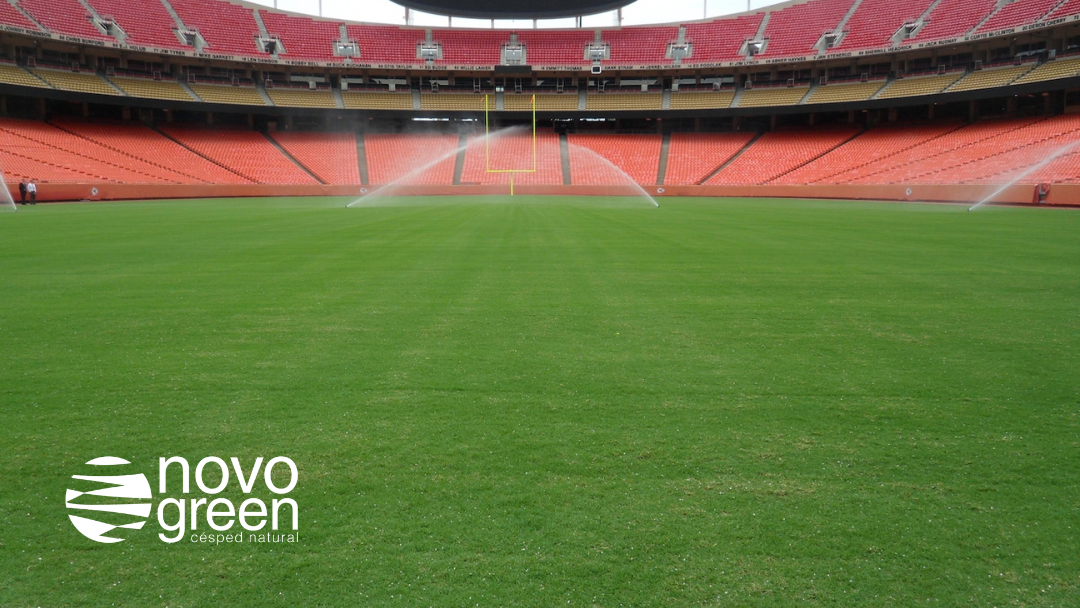
In a football field, Water conservation must coexist with requirements such as wear resistance, stability, and recovery speed.
In a golf course, The decision may be different for greens, tees, fairways and roughs, since each area has different functional needs and cutting heights.
And in a coastal project, Salinity can become a more important criterion than theoretical water consumption, making certain varieties of Paspalum particularly interesting.
Therefore, an excellent variety can be a bad choice if used in the wrong project.
Sustainability is using fewer resources to achieve the necessary result
Water conservation is essential, but it should not be analyzed in isolation.
A sustainable lawn surface should also be assessed for its climate adaptation, durability, fertilization needs, resistance to health problems, mowing frequency, recovery capacity and useful life.
A variety that uses less water but requires continuous corrective action may not be the most efficient solution overall.
Similarly, a variety with good vegetative recovery can reduce certain repair or replacement needs. A heat-adapted variety can withstand the summer with less stress. And a salt-tolerant species can allow the use of water resources that would not be suitable for other types of grass.
This approach is especially important in the new generations of C4 species, where genetic improvement is allowing simultaneous work on different characteristics related to sustainability, resistance and quality.
Saving water starts before you turn on the sprinklers
The water efficiency of a lawn surface begins long before the sprinklers are programmed.
It begins with studying the climate and soil. It continues with selecting the species and, especially, the variety. It then depends on proper planting and the development of a healthy root system. And only then does efficient irrigation management come into play.
Our experience working with different species, varieties, and project conditions leads us to a clear conclusion: There is no single most sustainable lawn; there is only a lawn that is better or worse suited to each situation..
In warm, Mediterranean climates, new generations of Bermuda, Zoysias and Paspalum They offer particularly interesting possibilities due to their adaptation to high temperatures, water efficiency, resistance and, depending on the species and variety, recovery capacity or tolerance to specific conditions such as salinity.
But no genetics can replace good design and proper maintenance.
Therefore, when water conservation is a priority, we shouldn't limit ourselves to asking:
“Which grass uses less water?”
The question that truly allows for a technical decision is:
“"What species and variety can deliver the results this project needs while using resources as efficiently as possible?"”
That's where truly efficient and sustainable natural grass management begins.


