When a natural grass surface is going to withstand heavy use, choose the right variety It is crucial. Sports fields, hotels and resorts, parks, common areas, heavily used gardens, or certain areas of a golf course can subject the grass to continuous wear and tear, and not all varieties respond in the same way.
But talking about traffic-resistant turf that may be too simplistic.
In a professional project, it's not just important to know how much use a surface can withstand before deteriorating. It's also important how it recovers after damage, how long it takes to reseal the cover, and what conditions it needs to do so..
Therefore, resilience and recovery should always be analyzed together.
Table of Contents
Withstanding traffic and recovering from damage are not the same thing
Traffic causes physical damage to leaves and stems through footsteps, running, braking, turning, or the passage of machinery. As the intensity of use increases, so does the risk of loss of density and cover.
The wear resistance It indicates the extent to which the grass is able to withstand that pressure while maintaining its characteristics.
The recovery capacity, However, it determines how it responds once the damage has already occurred.
This difference is especially important on sports surfaces. A football pitch, for example, does not experience uniform wear: goals, touchlines, warm-up areas, and certain playing areas can suffer much greater pressure than the rest of the pitch.
In these cases, good resistance is important, but so is having a lawn capable of recolonize damaged areas rapidly during their active growth period.
Stolons and rhizomes: the ability of grass to close damaged areas
The growth pattern of each species directly influences its ability to recover.
The stolons These are stems that develop horizontally across the ground and generate new growth points. rhizomes They perform a similar function below the surface.
Species capable of developing through these mechanisms can vegetatively reoccupy areas where cover has been lost.
This is one of the reasons why the Bermuda They are particularly interesting on surfaces subject to heavy traffic. Their growth via stolons and rhizomes allows for very active recovery when temperature, water, and nutrient conditions are suitable.
The Zoysias They also exhibit vegetative growth, and many varieties form extremely dense and resilient surfaces. However, not all varieties recover at the same rate.
And this nuance leads us to one of the most important criteria for choosing correctly.
For high traffic, variety matters as much as species.
Not all Bermuda shrimp behave the same. Nor do all Zoysia shrimp.
Modern genetic improvement programs allow the selection of varieties for specific characteristics such as wear resistance, density, recovery, tolerance to heat, cold, drought or shade.
Within the Bermuda countries we work with, we find good examples.
Latitude 36 It combines high resistance to trampling and recovery capacity with a particularly interesting cold-weather performance within the Bermuda category.
Northbridge It is another variety developed with a clear orientation towards sports surfaces and stands out for its mechanical behavior, density and recovery.
Tifway 419, Widely used historically in sports and golf, it also exhibits high resistance to traffic and good regeneration capacity through stolons and rhizomes.
Within the Zoysia genus, we find different profiles. Varieties such as Zeon, Geo, Stadium or Lazer They can provide high density and wear resistance, but they differ in recovery, texture, shade, maintenance needs and other conditions.
Paspalum trees are also a very interesting alternative for surfaces subjected to heavy use. Varieties such as Platinum TE and SeaIsle 2000 They combine density, strength and resilience, in addition to their well-known tolerance to salinity, so they can be especially interesting in certain sports, golf and landscaping projects.
Therefore, in demanding projects, the decision should not be left to “Bermuda or Zoysia”. We need to get to the specific variety.
Bermuda or Zoysia for high-traffic areas?
Both groups can offer excellent results, but they respond to different needs.
The Bermuda They are particularly notable for their ability to grow and recover during the warmer months. When they are in full vegetative activity, they can quickly repair damaged areas, a very valuable characteristic in sports facilities and surfaces subject to continuous wear.
The Zoysias They are notable for forming very dense and resistant surfaces. Some varieties also have low mowing, watering, and fertilization requirements, which can be especially advantageous for landscaping, hotels, resorts, gardens, and green spaces subject to frequent use.
The decision will depend on what the main objective is.
One surface may require maximum recovery speed. Another may prioritize density, ornamental quality, and lower maintenance. And in yet another, shade, cold, or water availability may end up being the deciding factors. determining factors.
The usage schedule also matters
A variety can only express its resilience when it is actively growing.
This point is especially important with the C4 species, such as Bermuda, Zoysia, and Paspalum.
Their peak activity coincides with high temperatures. During spring, summer, and part of autumn, they can exhibit an excellent response to wear and tear, but when temperatures drop, their growth slows and they may enter dormancy.
Therefore, in a professional installation it is advisable to cross the surface usage schedule with the grass growth schedule.
In a resort, a pool area or many Mediterranean landscaped areas, the period of maximum use coincides precisely with the time of greatest activity of the C4.
In a sports facility used intensively during the winter, the approach may be different and require specific management or reseeding strategies.
The ground also has to withstand the traffic
Genetics alone cannot solve all the problems arising from intensive use.
The repeated passage of people, players, or machinery can produce soil compaction. When this occurs, the space available for air and water decreases, infiltration is hindered, and the roots encounter greater limitations in their development.
The result is a surface that is progressively less prepared to handle the same traffic that it initially supported correctly.
Therefore, in high-traffic areas, aspects such as the following are especially important:
- proper soil preparation
- adequate drainage
- prevention and correction of compaction
- aeration when necessary
- irrigation and nutrition adjusted to the level of use
In sports surfaces, where the demands are much greater, the construction of the profile and drainage become even more important.
A resilient lawn also needs soil that allows it to be resilient.
Not all traffic is the same
Nor should we use a single definition of "high traffic".
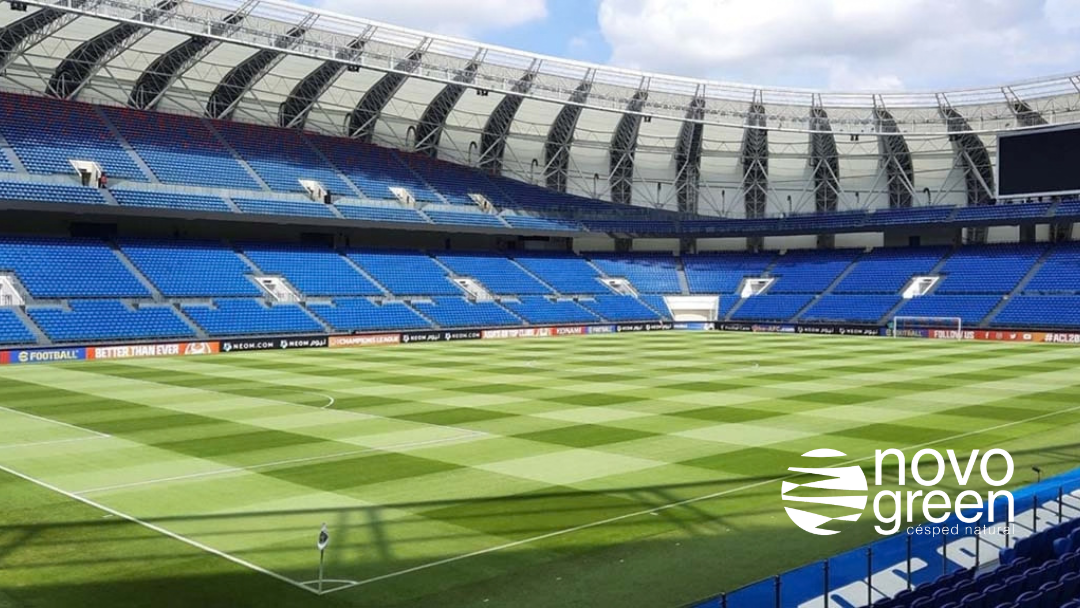
A football field It withstands racing, turns, braking, and wear concentrated in certain areas. Recovery becomes critically important here.
In a hotel or resort, Traffic may be concentrated around swimming pools, terraces, entrances, or event spaces. In addition to durability, a high level of decorative quality is typically desired.
In parks and public green spaces, The use can be continuous and difficult to control, so it is important to combine resistance, recovery and ease of maintenance.
In residential gardens, Children, pets, play areas or swimming pools can also generate considerable pressure.
And in golf, Tees, green access and regular routes may have much higher requirements than the surrounding areas.
The variety should be chosen with the following in mind: how the surface will actually be used, not only in a generic resistance classification.
When use is extreme, it may be necessary to reinforce the natural grass.
There are sports facilities where the number of hours of use and the availability requirements exceed what a conventional surface can reasonably withstand.
These projects can utilize solutions from hybrid turf, where natural grass grows integrated into a synthetic reinforcement structure.
At NOVOGREEN we work with NovoGrass H-22, This solution was developed for sports fields and surfaces subjected to very high traffic. The system's objective is to increase the stability and resistance of the surface while maintaining the characteristics of natural grass.
Hybrid turf isn't necessary for every high-traffic area. It's a specific solution for projects where the intensity of use justifies that extra level of reinforcement.
The sod allows you to start from an already developed surface
The implementation system is also important when there are short deadlines or when a surface needs to be recovered quickly.
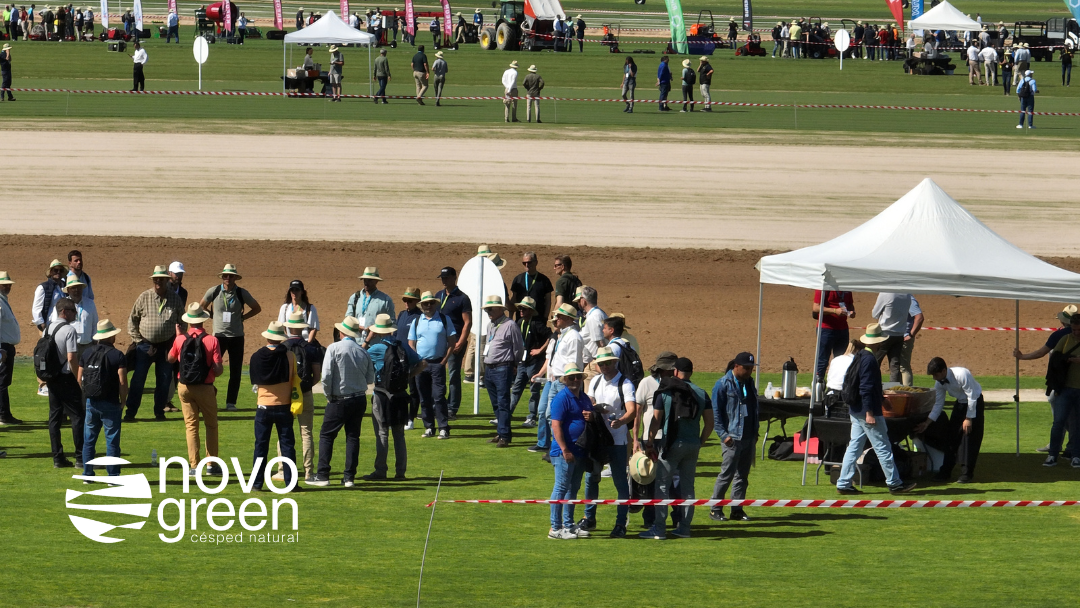
With the turf, The turf arrives at the project after having been cultivated for months under professional conditions. The density, maturity, and uniformity of the turf have been developed beforehand on the property, avoiding the need to complete that entire process from scratch at the final location.
This represents a significant advantage over sowing when a formed surface is needed in a short time.
Once installed, light use may be acceptable when conditions permit, but Heavy traffic should wait until there is sufficient rooting with the receiving soil.
In areas subject to heavy use, this difference is especially relevant: it is not enough for the surface to look finished; it must be agronomically prepared to withstand the loads it will receive.
So, what should a good lawn for heavy traffic have?
We wouldn't be looking for a single characteristic, but rather a balance.
A lawn intended for intensive use should have good wear resistance, sufficient density and recovery capacity in accordance with the intensity of use. In addition, it must be adapted to the climate and compatible with the available soil, exposure, water, and maintenance.
In sports, recovery speed may be paramount. In a high-end resort or garden, density, ornamental quality, and maintenance may be more important. In a public park, robustness and ease of management are key. And in extreme situations, hybrid solutions may be necessary.
Our experience in sports turf, golf, landscaping and gardening leads us precisely to avoid universal recommendations.
The most resistant variety is not necessarily the best for all projects.
The right decision is to select the one that can withstand the intended type of use and recover from wear and tear under the actual conditions in which it will have to operate.
Because when we talk about natural grass for high-traffic areas, knowing how much it can withstand is just as important as knowing... how and when will it be able to recover.