



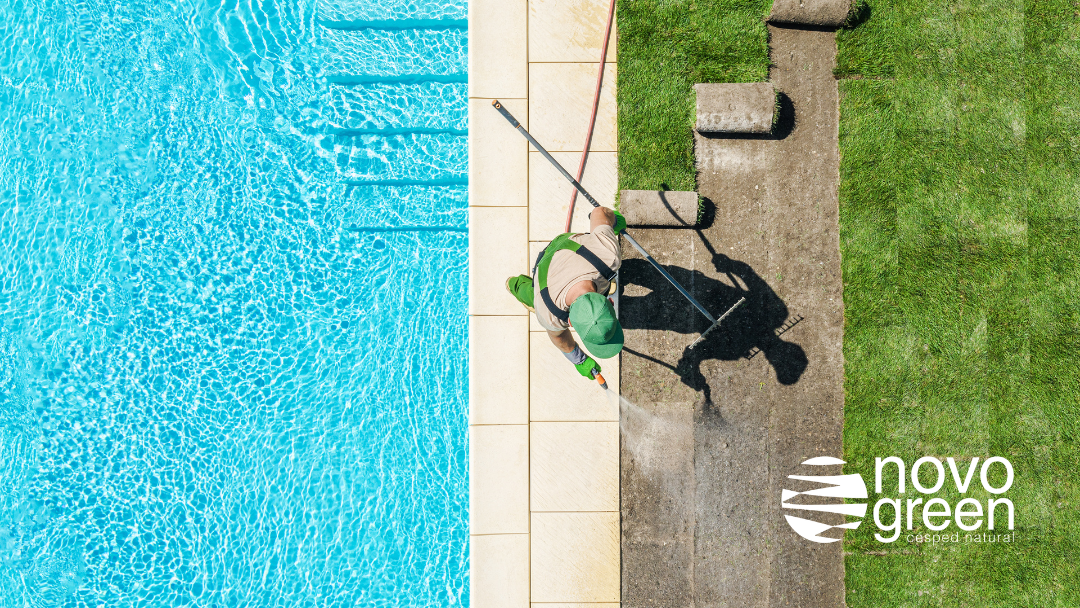
A garden with a swimming pool demands much more from the lawn than it might seem. During the summer months, it's the focus of much of the outdoor activity: people going in and out of the water, sun loungers, games, walkways, wet feet, and especially heavy use just when temperatures are at their highest.
Furthermore, in these types of projects, the lawn plays a significant aesthetic role. It forms part of the garden design and must be integrated with the pool, paving, vegetation, and other landscaping elements.
Therefore, choosing natural grass for a pool area should not be reduced to looking for a variety that "withstands the heat". A balance must be found between ornamental quality, resistance to wear and tear, water and maintenance needs, sun exposure, and performance during the months when the garden will actually be enjoyed.
Table of Contents
Summer is the key time
In a conventional garden, we can assess the behavior of the lawn throughout the year. In a house with a pool, hotel, resort, or residential community, an additional factor arises: The period of peak usage usually coincides with the warmest months..
This significantly changes the selection criteria.
C4 species, such as Bermuda and Zoysia, These plants experience their greatest vegetative activity under high temperatures and intense sunlight. It is precisely when the use of swimming pools and outdoor spaces increases that these species are at their peak growth periods.
This can be a significant advantage in warm and Mediterranean climates: good adaptation to heat, water efficiency, and the ability to respond to wear and tear during peak usage periods.
The downside is their winter behavior. When temperatures drop sufficiently, C4 plants reduce their activity and can enter dormancy, temporarily losing their green color.
Therefore, we shouldn't dismiss or select a variety solely based on its appearance in winter. We need to ask ourselves... In which months do we need the garden to offer its best performance?.
Around a swimming pool, not everything is about aesthetics.
A lawn area next to a swimming pool should be visually appealing, but also functional.
Entering and exiting the water creates repetitive patterns. Sun loungers are moved and remain in certain spots for hours. Children play and run around. In hotels and resorts, the number of users can multiply during the summer.
Therefore, we must value the resistance to trampling, but also the ability of the grass to recover small damaged areas.
There are important differences between species and, above all, between varieties.
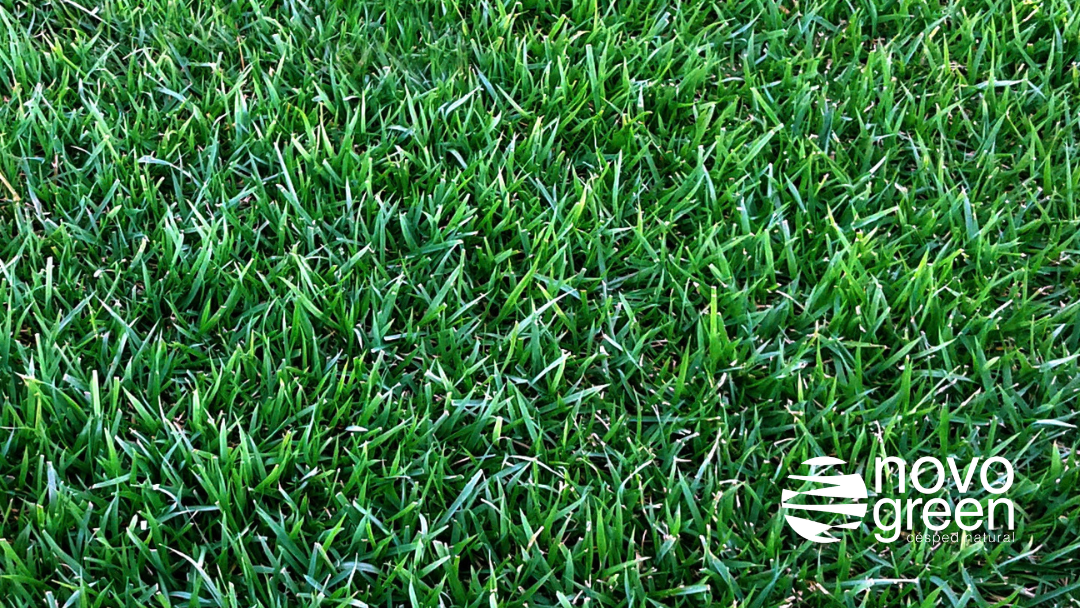
Bermuda grass grows via stolons and rhizomes and can exhibit a high recovery capacity during its active period. Some Zoysia grasses grow more slowly but form very dense surfaces with high resistance to wear.
There is no one-size-fits-all solution. The level and type of intended use must be part of the choice.
Zoysia: a particularly interesting option around swimming pools
Zoysias have several characteristics that make them very interesting for gardening and landscaping.
They form dense surfaces, exhibit high tolerance to heat and drought, and, depending on the variety, may require relatively infrequent mowing. At NOVOGREEN, we have been working with different Zoysia varieties for years precisely because within the same family Among the Zoysias species, we find sufficiently different behaviors. as well as being able to adapt to very different projects.
For example, Zoysia Empire It is a medium-leaf variety and a bluish-green color, with high resistance to trampling, very low water requirements, and infrequent mowing. Its data sheet specifically mentions its use in gardening and landscaping.
Zoysia Zeon It offers a distinct profile: fine leaves, dark green color, and a high-density surface. It exhibits very high resistance to trampling, very low water requirements, and superior shade tolerance compared to many warm-climate varieties. Its applications also include resorts and landscaping.
These differences are important. In a project where fine texture and carefully crafted aesthetics are paramount, we can arrive at a different choice than in a family area subjected to heavy use.
Choosing Zoysia doesn't end the decision: you have to choose which Zoysia.
And Bermuda?
It can also be an excellent solution.
There's a tendency to associate Bermuda shorts almost exclusively with football, golf, or large sports facilities. However, certain varieties work perfectly well in gardening, landscaping, residential areas, hotels and resorts, provided the conditions are suitable.
Its main strength around a pool appears when we combine lots of sun, high temperatures and frequent use.
Bermuda grass tolerates heat very well and many varieties exhibit high resistance to wear and tear and a great capacity for recovery during active growth.
A variety such as Tifway 419, For example, it is suitable for both gardening and sports facilities and has good resistance to drought and wear.
In other projects, we might be interested in more modern Bermuda shorts such as TifTuf, Latitude 36 or NorthBridge, each with different characteristics in water efficiency, cold weather behavior, density or recovery.
The point we should pay particular attention to is sun exposure. As a group, Bermuda grass thrives in plenty of sunlight, so a very shady garden might lead us to consider other options.

The pool water shouldn't determine the species, but it should be taken into account.
It's common to wonder if pool chlorine can damage the lawn.
The small amounts of water that occasionally splash onto the lawn are not usually the main constraint on the project. A different situation would be a frequent or concentrated spill of treated water directly onto the same area.
We must also differentiate between a conventional swimming pool and a saltwater pool. In the latter case, the continuous accumulation of salts can become an additional problem, especially if there is a significant and repeated application of salt to the lawn.
If salinity is indeed a constraint on the project—something more common in coastal environments, saline irrigation waters, or certain facilities—there are species that are particularly interesting due to their tolerance, such as Paspalum vaginatum.
The important thing is not to choose a variety simply because it "tolerates chlorine" or "tolerates salt." First, you have to determine if that factor is actually significant enough to influence the selection.
A garden with a swimming pool shouldn't require us to water continuously.
Pool water and irrigation water are two completely different things.
In warm climates, where the garden is used intensively during the summer, water efficiency is playing an increasingly important role in project design.
Therefore, within our selection for gardening, we work with varieties capable of maintaining high quality with limited water requirements. Zoysias such as Empire or Zeon and Bermuda as TifTuf These are examples of varieties developed or selected for characteristics that are especially interesting in the face of heat and drought.
But installing an efficient variety does not in itself guarantee low consumption.
Soil type, root depth, irrigation system uniformity, sun exposure, and management will determine actual water consumption. A well-chosen lawn with a poorly designed irrigation system can end up using more water than necessary.
Sun, shade and architecture: you have to look at the whole garden
In projects with swimming pools, it is especially common to find very different situations within a few meters.
There can be a large area completely exposed to the sun and, at the same time, areas shaded by the house, porches, walls, pergolas or trees.
An excellent variety in full sun can lose density when it receives less radiation than necessary.
That's why it's worth studying the actual hours of daylight in the most vulnerable areas, not only to consider that the garden, in general terms, is sunny.
This point can change the choice between Bermuda and Zoysia and even lead us to different solutions when the shade is very intense. NOVOGREEN let's consider precisely climate, shade, salinity and use among the determining factors for selecting a variety.
We must also keep in mind that no natural lawn thrives in insufficient light. Choosing a shade-tolerant variety expands the window of opportunity, but it doesn't eliminate the plant's physiological needs.
Maintenance matters, especially in an area we want to enjoy.
There is a very practical issue that is sometimes left out of the selection: How much maintenance are we willing to take on?
In a residential garden, hotel, or resort, the goal should not be to continually dedicate resources to keeping the lawn in good condition.
The frequency of mowing can be especially relevant around swimming pools and patios. Each mowing involves machinery, plant debris, subsequent cleanup, and an intervention in an area primarily intended for leisure.
Zoysia grasses offer an interesting advantage here. Some varieties have relatively slow vertical growth, allowing for a significant reduction in mowing frequency compared to faster-growing lawns.
This doesn't mean they are "maintenance-free" lawns. All lawns need proper care. But Choosing the right variety allows you to significantly adjust the amount of resources the garden will need for years to come..
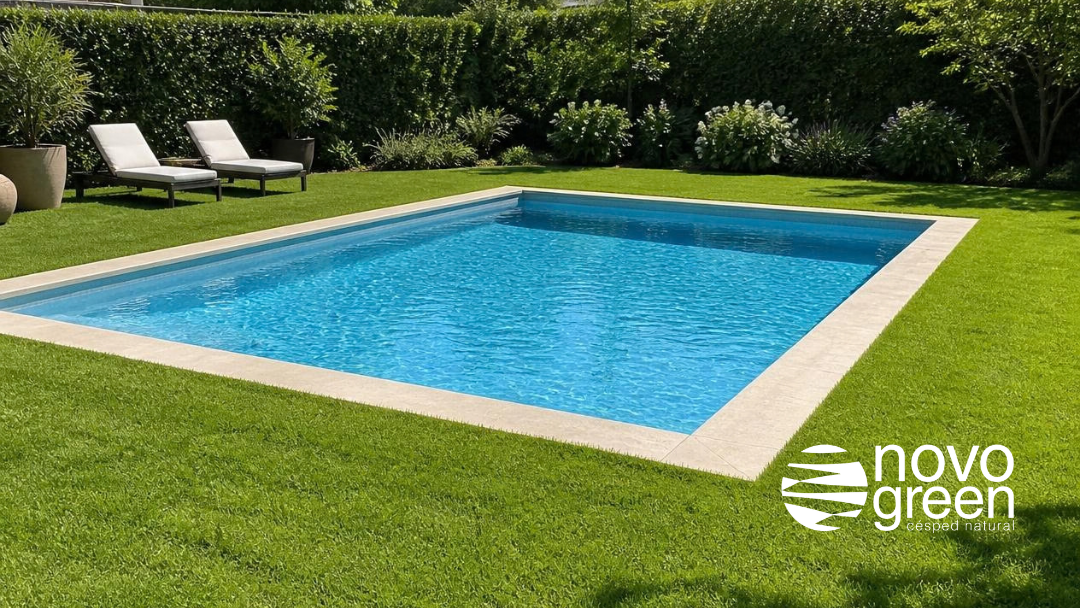
Turf makes especially sense in a garden with a swimming pool.
In this type of project, the implementation system is also important.
Sowing means initiating the germination, growth, and maturation process in your own garden. During this period, the use of the land should be limited, and there is a greater risk of problems such as irregular emergence, weeds, erosion, or the need for reseeding.
With the turf, Much of that process has already been carried out previously on our production farms.
The turf arrives as a fully formed, dense, and homogeneous plant cover that is installed on the prepared ground. Once in place, the rooting process begins with the receiving soil.
In a garden with a swimming pool, this has an obvious advantage: It greatly reduces the period during which outer space is in the process of formation..
During the first few days, we must be especially careful with watering and avoid heavy use until the turf is properly rooted. But visually, the change is practically immediate, and the garden can reach its final configuration in a much shorter time than with seed planting.
So, what kind of grass should you choose around a swimming pool?
Before choosing a specific variety, we would analyze five issues: climate, hours of sunlight, intensity of use, water availability and expected maintenance level.
Then come the aesthetic criteria: leaf texture, density, tone and winter behavior.
In a sunny Mediterranean garden that is heavily used in summer, C4 species should be among the first alternatives to consider. Zoysia This can be especially interesting when we are looking for density, ornamental quality, resistance, and relatively low maintenance. Bermuda It can be advantageous when there is a lot of sun and we place special importance on recovery capacity.
But the final decision should always come down to variety.
We're not just looking for a lawn that looks good around the pool on the day it's installed. We're looking for a surface capable of Maintaining that quality for years with water consumption and care consistent with the project.


