





When a lawn develops problems a few weeks or months after installation, it's common to look for the cause in the grass variety, irrigation, fertilization, or maintenance. However, in many cases, the source lies deeper: on land that was not properly prepared before planting the grass.
Soil preparation is one of the phases that most influences the subsequent performance of a lawn. It affects root development, water infiltration and availability, drainage, nutrition, and ultimately, the lawn's ability to withstand heat, drought, foot traffic, and other stress factors.
Furthermore, there is an important difference compared to other maintenance work: Correcting the ground before installing the turf is relatively simple; doing so once the surface is already established can be much more complex and expensive..
Therefore, in both gardening and landscaping, as well as in sports projects, taking the time to understand and properly prepare the soil is not delaying installation. It's building the foundation upon which the turf will have to grow for years.
Table of Contents
Error 1. Only preparing the first few centimeters
One of the most frequent mistakes is confusing a visually prepared surface with a truly prepared floor.
Raking, removing stones, and leaving a thin surface layer may be enough to achieve a good appearance before laying turf or sowing seeds, but it doesn't tell us what the root will find when it starts to develop.
Below there may be layers compacted by machinery, construction debris, heterogeneous materials or discontinuities that hinder the movement of water and root growth.
The goal should not simply be to have a few superficial centimeters of seemingly good soil, but to achieve a soil profile suitable for root development.
A lawn with a larger volume of accessible soil can access more water and nutrients and respond better to stressful situations. Therefore, before working only on the surface, it's important to know what's actually underneath.
Error 2. Not knowing the soil before modifying it
Adding topsoil, sand, or organic matter without knowing the starting point does not guarantee improvement.
The texture and structure of the soil determine how it infiltrates, retains, and drains water. A predominantly sandy soil behaves very differently from one with a high clay content, and any necessary adjustments should address specific problems.
It is also useful to know chemical parameters such as pH, salinity, and nutrient levels, especially in professional projects or when there is a history of problems on the plot.
A preliminary analysis allows for informed decisions: knowing whether we really need to make an amendment, correct a characteristic, or simply improve physical preparation.
Modifying a floor without diagnosing it can replace one problem with another.
Error 3. Working on compacted ground
Compaction is one of the problems that can most limit the performance of a lawn.
It can appear after earthmoving, machinery operation, construction work, or repeated traffic on the plot. The soil may appear visually sound and yet exhibit high resistance to root growth.
When the pore space decreases, the circulation of air and water is hindered, and the root system encounters more obstacles to its development.
The result may later manifest as weak turf, areas that dry out quickly, waterlogging, uneven growth, or a poorer response to foot traffic.
In these cases, placing turf on the surface does not eliminate the problem. The turf provides a pre-developed plant cover, but its roots will have to colonize the receiving soil.
That is why it is important to correct the compacted layers beforehand and leave a structure that allows good contact between the turf and the ground and facilitates subsequent rooting.
Error 4. Trying to solve a drainage problem by increasing irrigation
When an area of the lawn begins to deteriorate or dry out, a common reaction is to increase the time or frequency of watering.
But water isn't always lacking.
Soil with poor infiltration can receive sufficient irrigation, but the water may not be distributed properly. This can lead to surface runoff, water accumulation in low-lying areas, or significant differences in moisture between different zones.
In areas with poor drainage, the opposite problem also occurs: excess water and lack of oxygen in the root zone.
Before installing the turf, we must observe how the ground behaves in the presence of water, identify low points, and check that the slopes and drainage are adequate.
An efficient irrigation system cannot indefinitely compensate for poorly structured soil.
Error 5. Failure to properly remove existing vegetation
Installing a new lawn on land where weeds, plant debris, or unwanted species remain can cause problems from the start.
Preparation should remove the previous vegetation and, where necessary, its propagation structures. Some weeds may regrow through the new lawn if the preparation work was insufficient.
This is especially important with perennial species or those capable of propagation through rhizomes, stolons, or other vegetative organs.
A clean surface before planting reduces initial competition and avoids having to carry out much more difficult actions later when the desired grass is already established.
Error 6. Not thinking about the irrigation system before installing the lawn
Irrigation should be designed and tested before laying the turf, not after.
Sprinkler distribution, available pressure, range, overlap, and sectorization will determine whether all areas receive a reasonably uniform amount of water.
This is especially important in gardens with complex geometries, narrow areas, trees, slopes, or different sun exposures.
Poor uniformity often necessitates longer watering periods to ensure that deficient areas receive sufficient water. As a result, other areas end up receiving more than they need.
Before installing the turf, it is advisable to check the system's operation and correct any nozzles, sections, or inadequate coverage.
Saving water also begins during land preparation.
Error 7. Leaving uneven surfaces thinking that the turf will correct them
The turf adapts to the surface on which it is installed. It does not, by itself, correct unevenness.
Small depressions can become areas where water accumulates. Raised areas can create zones more prone to drying out or make even mowing difficult.
In sports surfaces, leveling defects can also affect the functionality and safety of the terrain.
Before installation we need a surface regular, stable and with the slopes planned to properly evacuate water, while avoiding excessive compaction.
The quality of the initial leveling will continue to be noticeable long after the grass has taken root.
The ground should be firm, but not excessively compacted.
Preparing the soil correctly requires finding a balance.
If the soil is too loose, it can settle unevenly after the first few waterings and create depressions. If it's too compacted, it will limit infiltration, aeration, and root growth.
Therefore, after the preparation and leveling work, a sufficiently firm and stable surface must be achieved, but with physical conditions suitable for the development of the roots.
This point is especially important when installing turf.
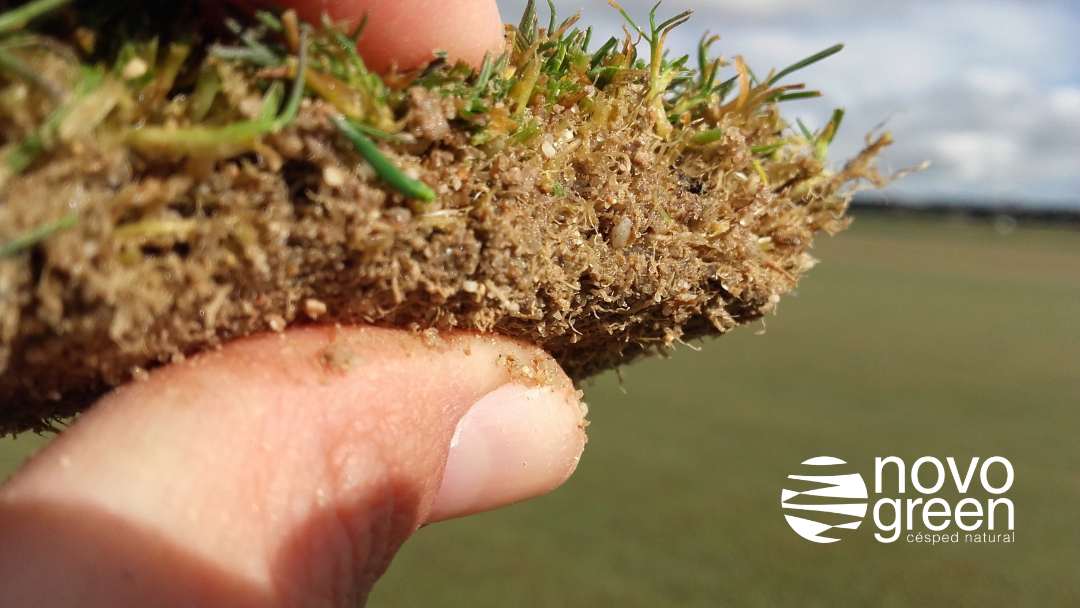
We need good contact between the base of the turf and the receiving soil, without air pockets or irregularities, to promote moisture retention and the emission of new roots into the ground.
The preparation also depends on the type of grass we are going to install.
We shouldn't prepare the ground first and then decide what grass to use.
The choice of species and variety, the planting system and the future use of the land are all part of the same project.
A residential garden, a hotel, a football pitch, or a golf course have different requirements. The approach also changes if we expect high traffic, if we have water with salinity problems, or if we're going to be working with specific cutting heights.
At NOVOGREEN we work with different Bermuda grass, Zoysias, Paspalum, and C3 species, In addition to various planting solutions, prior knowledge of the variety allows for better adaptation of both preparation and subsequent maintenance.
Especially in professional projects, Soil and turf should be designed together, not as two independent decisions.
When we install turf, we are transferring a already developed lawn to the project.
One of the main advantages of turf is that the grass does not start its development from scratch in its final location.
It has been cultivated for months on our farms, where it has previously developed density, homogeneity and maturity under controlled production conditions.
But that advantage must continue on the receiving side.
Poor preparation can limit the rooting of even high-quality turf. Conversely, when the surface is properly prepared, good soil-turf contact and appropriate irrigation management allow for rapid integration between the two.
During the first few days, the goal is to maintain sufficient moisture to promote this process. As the root system develops, irrigation management can gradually evolve towards a regime more typical of an established area.
The final result therefore depends both on the quality of the plant material as well as the conditions it encounters upon arrival at the project.
Preparing the land is an investment that isn't visible, but its benefits are felt for years to come.
Once the turf is installed, much of the previous work is hidden.
We don't see the soil decompaction, amendments, leveling, drainage, or root zone preparation. But we will see the consequences.
We will see them in how water infiltrates, in the depth of the roots, in the uniformity of the surface and in the ability of the lawn to cope with heat, drought or traffic.
Therefore, properly preparing the ground should not be considered a secondary phase of the installation.
In professional projects and in quality gardens, It is one of the decisions that will most influence the future behavior of the surface..
We can select an excellent variety and start with a high-quality turf, but if underneath there is compacted, poorly drained or poorly leveled soil, we will be limiting the potential of that lawn from day one.
The planting process begins before the first turf is laid.
And, in many cases, What we do before we even see the grass will be precisely what determines how we see it for years to come..